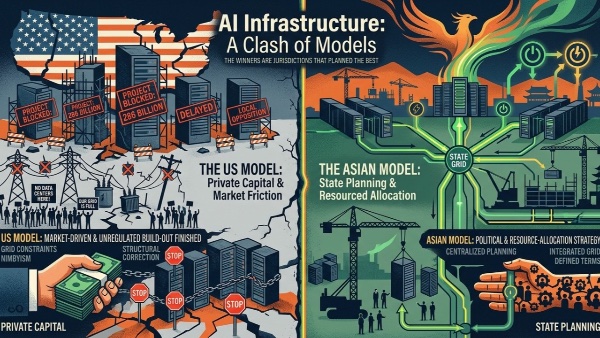
There is no force that can stop an idea whose time has come – that idea is NOT data centers.
Software efficiency has been sacrificed to hardware innovation for 40 years.
Now, software engineering is catching up with chip design eliminating the need for massive data centers – or better said, making every data center deliver many times its current output.
Data centers aren’t going away – there will simply be far fewer doing much greater work – than anyone suspects.
These kind of discoveries always come, hidden to conventional commentary, at the very moment the world is captured in a frenzy which fails to materialize.
META is reported to be building a data center the size of Manhattan.
If you want to experience how extreme the commentary has become, tune into Fox News, particularly Stuart Varney interviewing the 100th person about how every neighborhood will one day have its own data center – for A.I. of course.
If you were old enough in 1999 and 2000, you experienced another frenzy – with literally thousands of .com companies, each with gazillion dollar valuations, coming to market, every one of which disappeared shortly thereafter.
If you were paying attention, you also watched Fortune 500 companies, who ought to know better, spending billions of dollars to ensure their computer programs could go from 1999 to 2000 without putting the company out of business.
Some said planes might fall from the sky because their computer programs, written in the 1970s never expected to be extant when the century changed.
All these frenzies pale in comparison to the A.I. data center frenzy now at hand.
In the history of humanity, there has never been a frenzy, with unbounded investment, that survived “an idea whose time has come.”
That idea is software engineering, using time-tested innovations, which when put together enable quantum speed, on current hardware, today.
All the frenzy and investment on the planet cannot overcome this simple, FATAL equation:
Conventional software driving A.I. is I/O bound.
- I/O needs huge data centers.
- Optimize I/O and applications run 100 to a 1,000 times faster.
- Thus, you need 1/1,000th the number of data centers you think you need.
- That is the fatal equation undermining ALL A.I. investment today.
Said differently – every company, every government agency has – today, 10 times to 100 times more computing power than it thinks it has – because it runs I/O inefficient applications.
You don’t need data centers if you optimize I/O – or said another way, your existing data centers have much more capacity than you think they do.
The FATAL EQUATION is being proven every day.
The reason the FATAL EQUATION is so deadly for the data center world is their lag time – the time from concept to production.
That is 3 to 5 years.
Rural land will be bought at ridiculous prices.
Entire towns will be put under the threat of eminent domain – their bucolic farmland absorbed for hundreds of acres of solar arrays supporting the dinosaur data center.
Electric utilities will be forced – are being forced right now – into providing power for A.I. data centers.
Utilities will raise consumer rates to pay for that expansion – telling citizens their rates will go back down when those data centers get into production.
The FATAL EQUATION grinds on.
However, more companies, even some government programs, are beginning to move to I/O optimization – because they need quantum speed – as in 1,000 times faster than conventional tech – right now – not years from now.
You won’t hear about this in the tech press – because every tech reporter is writing about how the government is “partnering” with 1970s tech companies to build data centers.
The tech press is subsidized by the ancient tech dinosaurs like Oracle.
What they do not tell you, because they never wrote a full stack program without conventional tools – is it is I/O that drives the need for those data centers, not necessarily A.I.
Who are the early users?
They are not who you might think if you have never brought a disruptive technology to the market.
The first users aren’t pioneers, they are simply frustrated companies who need their databases to have higher performance and lower cost.
Shortly thereafter, some of the early adopters are the ones – and this is where low I/O is today – who have databases too big for conventional technology.
As we noted in the last post, databases for Oracle and the other relational technologies were used for CRM (managing your customers), billing, provisioning, logistics.
Those were big databases.
Then. Not now.
Then came devices, sensors, meters – and scores of other data generation machines adding a bunch of additional zeros to the data size.
The real issue, however, is even more challenging.
One needs not only to store the data – one must process it, query it, decision it – instantly.
Now we are in quantum land – this is what the quantum industry hopes to accomplish sometime in the far distant future.
Low I/O computing and emerging quantum computing however, deliver “quantum speed”, today, on existing hardware – or on hardware that does not use current data centers – by optimizing I/O and utilizing new hardware efficiently.
That is how the FATAL EQUATION is rolling out.
Another set of early adopters are not only looking for speed – these adopters have legacy databases – huge ones, each written in different years, by different teams for different, often unrelated problems.
Now data has enormous value – and it needs to be made available as if it were in a single merged database queried by highly skilled professionals tracking outcomes in the health space, for instance.
Low I/O technology enables databases of any size, any format, to be accessed and manipulated as if they were a single system – delivered in 90 days or less and, of course, NOT needing a data center.
The tech world is about to encounter the FATAL EQUATION:
- Data centers are for I/O.
- Optimize I/O and applications run 1,000 times faster.
- Thus they need 1/1,000th the hardware
- So either no need for a data center – or the one you have can run far bigger A.I. than anyone ever anticipated.
An idea whose time has come.