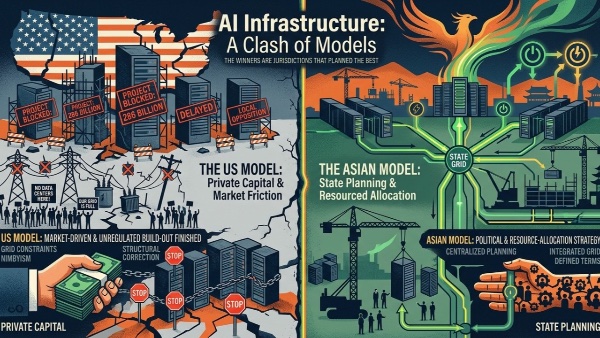
The trillion dollar wager on A.I. data centers is not a growth story.
It is a slow-motion structural failure, and the evidence is now impossible to ignore.
What follows is the full accounting of the dead projects, the broken grids, the burning capital, and the cold, calculating counter-strategy emerging from Asia.
Part I: The American Delusion – A Full Accounting
The Dead and the Dying
In September 2025, Google walked away from a $1 billion data center outside Indianapolis, pulling its Franklin Township proposal minutes before the city-county council was set to vote it down. That was not an isolated incident. It was the opening act of a rout.
Communities across the United States blocked or delayed more than $130 billion in AI data centers in the first three months of 2026 alone, a record quarterly pace that has only accelerated. In 2025, at least 48 data center projects worth approximately $156 billion were blocked or stalled due to local opposition. Combined, the total capital stranded or delayed by community resistance now exceeds $286 billion.
The trajectory is brutal and unambiguous.
Project cancellations jumped from six in 2024 to 25 in 2025, with more than 20 additional cancellations already logged in early 2026.
From January 2024 to May 2026, 46 AI data center projects across 20 states, representing investments between $137 billion and $172 billion, were stalled, blocked, or withdrawn entirely.
The corpses are piling up. In Arizona, a $14 billion project by Tract was withdrawn outright. In Virginia, a $24.7 billion QTS/Compass project became the target of lawsuits from local residents. And in July 2026, Blackstone’s QTS terminated its planned Digital Gateway data center project in Virginia, the largest data center campus ever proposed after years of local opposition and litigation.
If a project of that scale, with that level of political backing, cannot survive, no project is safe.
The Political Revolt
The numbers tell a story of a political shift that is tectonic in its speed. In August 2026, a survey of 2,007 U.S. adults conducted by Public First and the Information Technology and Innovation Foundation found that 46% of Americans oppose new data center developments in their communities, while barely 26% support them. Data centers are now the least favored form of local development among 10 types tested, less popular than warehouses, power plants, or wind farms.
The Annenberg Public Policy Center’s survey, also from August 2026, found that 61% of U.S. adults now somewhat or strongly oppose the construction of new data centers in their area, up from 49% just four months earlier. Only 14% are supportive. This is not a fringe movement. It is a broad, bipartisan revolt.
833 active community groups have sprung up across 49 states as of March 2026, united by complaints about massive electricity consumption, excessive water usage, noise pollution, air quality, and a permitting process many describe as opaque. New York imposed a moratorium on large new data center facility proposals in July 2026. Texas and New York have paused the issuance of permits for large data centers.
The industry’s response has been to seek out locations with fewer residents and less political friction. But those sites often lack the power grid infrastructure needed. The accelerating cancellation rate from 6 in 2024 to 25 in 2025 to 20 more in early 2026 indicates that community awareness is spreading faster than the industry’s ability to address concerns.
The ROI Catastrophe
The financial logic underpinning the entire buildout is collapsing under the weight of its own contradictions.
Bain & Company’s Automation and AI Pathfinder Survey 2026, covering 951 global companies, found that 40% of companies that tracked their AI spending recorded cost savings of less than 10% far below the 11% to 20% they had targeted. Only 4% of global respondents achieved AI-related savings of more than 30%. Bain’s report described the situation bluntly: “In reality, it is a circular bet with a structural leak.”
The Fifth Annual Domino Enterprise AI Report, which surveyed 639 senior enterprise AI leaders, found that the share of enterprises whose ROI fails to outpace their investment has remained at 57% since 2025, a plateau that has persisted for two years in a row, even as 93% report improved production capability.
The gap between capability and value is not closing. It is widening. Over 50% of enterprise AI budgets are allocated to sales and marketing functions, the areas where financial impact is hardest to isolate. Only 5-8% of enterprises can actually measure AI’s financial impact. And 49% of large organizations have cut AI agent rollouts when costs outran value.
The anecdotal evidence is just as damning.
Uber blew through its entire 2026 AI budget in the first four months.
Amazon shut down an internal leaderboard tracking employees’ AI activity after staffers were found running unnecessary autonomous bots to climb the rankings, a perfect metaphor for the performative nature of much corporate AI spending.
Part II: The Power Grid Is Breaking – And Ratepayers Are Paying
Virginia: The Canary in the Coal Mine
Virginia hosts the world’s largest concentration of data centers, and its grid is buckling under the weight. The numbers are staggering.
Dominion Energy’s Virginia Electric unit had fuel expenses of $2.31 billion in 2021. By June 2027, that figure is projected to reach $4.35 billion, an 88% increase. Fuel costs are the expenses Dominion pays to buy the coal, natural gas, and nuclear fuel to generate electricity.
The utility is increasingly forced to purchase power on the volatile wholesale market, where spot prices can skyrocket to several thousand dollars per megawatt hour during heatwaves and extended cold snaps.
23% of Virginia Electric’s energy supply now comes from the PJM wholesale market, up from 14% in 2021, driven directly by data center demand. The regional grid operator, PJM Interconnection, serves 67 million people from Washington, D.C. to Chicago, and its capacity market prices have risen sharply in recent adjustments.
The impact on ordinary Virginians is direct and painful. Virginia regulators approved rate increases of $11.24 a month for residential customers in 2026 and another $2.36 in 2027. Fuel costs could drive up the average monthly bill by as much as 13% to $195 from $173. The increase would only be about 5% if Dominion can issue bonds to defer some fuel cost recovery a band-aid on a hemorrhage.
The political backlash is already forming.
Governor Abigail Spanberger, a Democrat, said she would intervene in the regulatory review of NextEra Energy’s proposed $66.8 billion merger with Dominion to press for commitments on power bill affordability. The utility regulator’s staff said significant load growth from data centers increasingly exposes Dominion to wholesale market volatility.
Virginia’s experience shows what happens when digital infrastructure expands faster than the electric system can support. The state is now the canary in the coal mine for the entire American AI buildout.
South Korea: A Preview of the Coming Crisis
South Korea offers an even starker warning. AI data centers are projected to consume 128.9 TWh annually by 2037, equivalent to approximately 23.5% of the country’s total electricity consumption in the previous year of 549.4 TWh.
The government has announced plans for 18.4 gigawatts of AI data centers and four semiconductor fabrication plants requiring 6.3 gigawatts of power. If operated around the clock, the AI data centers would require about 161.2 terawatt-hours of electricity a year, while the new semiconductor fabs would need about 55.2 terawatt-hours.
60% of AI data center applications are concentrated in the Seoul metropolitan area, where the grid is already saturated. The government has been forced to introduce grid impact assessments to push development outside the capital region. This is not a market solution. It is crisis management.
Part III: Asia’s Counter-Strategy – State Power, Not Private Fantasy
While the United States relies on private capital racing into a regulatory vacuum, Asia is pursuing a fundamentally different model: state-directed, strategically prioritized, and resource-aware development.
The contrast is not subtle. It is civilizational.
China: $295 Billion and a Wall Around Nvidia
China is preparing to spend approximately 2 trillion yuan ($295 billion) over five years on building a nationwide network of AI data centers. State-owned telecom carriers like China Mobile and China Telecom will operate most of these facilities. The plan, led by the National Development and Reform Commission, mandates that at least 80% of AI accelerators used be domestically produced.
The strategic objective is explicit: domestic chip self-sufficiency.
In May 2026, nine domestic AI chips, including those from Huawei, Alibaba, Shanghai Biren Technology, and Moore Threads, passed review by China’s technology security agency, paving the way for large-scale adoption in high-security industries. Citigroup analysts believe the 80% localization target is achievable, as domestic AI chipmakers have already effectively captured the vast majority of China’s AI accelerator market, while imports of Nvidia’s H200 have essentially stalled.
Critically, power supply is less of a constraint for China.
Data centers currently account for only around 3-4% of the country’s total power consumption, and that figure is projected to rise to just 4.0% by 2026. China is not racing into a grid crisis. It is building with its eyes open.
India: A 21-Year Tax Holiday and a $70 Billion Bet
India has taken the most aggressive fiscal stance in Asia. The 2026-27 budget introduced a tax holiday until 2047 for foreign companies providing cloud services to customers globally using data center services from India. The exemption applies from Tax Year 2026–27 to Tax Year 2046–47 a 21-year commitment that no other major economy has matched.
A safe harbor of 15% on cost has also been proposed where the data center service provider in India is a related entity. The government says investments of around $70 billion are already underway, with announcements of investments of around $90 billion.
This is not speculative capital chasing a hype cycle. It is policy-driven infrastructure investment with a 20-year horizon. India generates nearly 20% of the world’s data but currently stores only a fraction domestically. The tax holiday is designed to close that gap.
Thailand: The Brake That Will Save the Market
In September 2026, Thailand’s government made the most decisive intervention in the region: it paused 166 data center projects, 49 already under construction and 117 awaiting approval, while government agencies drafted nationwide standards governing water, power, site selection, and environmental safeguards.
Deputy Prime Minister and Finance Minister Ekniti Nitithanprapas framed the pause not as rejection but as prioritization: Thailand wants projects that “generate jobs, income, and technological benefits,” not “simply providing space for servers.”
The decision exposed a fundamental flaw in the industry’s expansion: investors currently seek permission separately from electricity utilities, water authorities, and local building regulators. Each agency assesses matters within its remit, leaving no single body with a complete view of a project’s resource needs, proximity to communities, or economic returns relative to its costs. Some data centers are even registered under other business categories, including warehousing, making it harder to establish the industry’s true scale.
Four subcommittees have been given one month to prepare new criteria covering economic benefits, infrastructure, locations, and the environment. The new rules will regulate water and electricity use, locations, and safety while promoting clean energy and technology transfers.
This is what adult supervision looks like.
Singapore: Controlled Liberalization with Green Mandates
Singapore, which imposed a moratorium on new data center builds from 2019 to 2022, has reopened its market but on its own terms. The second Data Centre Call for Application (DC-CFA2) allocated 200 MW of new capacity, more than double the 80 MW allocated under the first exercise, to four operators: Digital Realty, Equinix, Keppel Data Centres, and ST Telemedia Global Data Centres, each receiving 50 MW.
The mandates are non-negotiable. Operators must meet at least half of the new facilities’ power consumption via green energy and deliver best-in-class energy-efficient performance, including through the adoption of liquid cooling. They must also enhance Singapore’s advanced compute capabilities for AI and facilitate R&D via collaborations with Singapore-based partners.
More than 20 projects bid for the capacity, and the authorities confirmed the four projects were selected “for their ability to holistically meet the desired outcomes” across strategic, economic, and sustainability components.
As Nicholas Hanna of Pinsent Masons MPillay put it, “Singapore is making clear that access to capacity here comes with real obligations: on technology, on economic contribution, and on green energy. Green energy obligations, R&D partnership arrangements, and infrastructure development timelines are no longer peripheral considerations in a data center deal in Singapore. Instead, they sit at the center of it.”
This is not a market free-for-all. It is managed growth with hard sustainability guardrails.
Malaysia: The Spillover Beneficiary
Malaysia, particularly Johor, has become the primary beneficiary of Singapore’s constrained capacity.
AirTrunk is investing RM12 billion ($3.02 billion) to build two new hyperscale campuses in Iskandar Puteri, Johor, called JHB3 and JHB4. The four campuses will have a combined IT load of more than 700MW, bringing the company’s total committed investment in Malaysia to approximately RM27 billion ($6.8 billion).
In the first half of 2026, data center and cloud projects accounted for 44% of Malaysia’s total approved investments. Disclosed data center transactions in Johor alone totalled RM1 billion in that period. YTL Power is developing a gigawatt-scale campus in Sedenak. Malaysia is capturing demand that Singapore cannot physically accommodate and doing so with a clearer regulatory framework than the United States.
Japan: AI Sovereignty as National Strategy
Japan is pursuing what it calls “AI sovereignty,” building domestic infrastructure to reduce reliance on both the US and China. AI data center capacity is projected to grow from 1.1 GW at the end of 2025 to 4.9 GW by 2033, a 4.5-fold increase.
The investment commitments are staggering. Blackstone plans to invest $30 billion in Japanese AI data centers over the next three to five years, developing more than 1GW of capacity. GMI Cloud has launched a $12 billion sovereign AI infrastructure initiative in Japan, partnering with Wistron to build a 1 GW facility in Kagoshima Prefecture. Microsoft alone has committed $10 billion to expand its AI and cloud infrastructure in Japan from 2026 to 2029.
Of the 26 major companies operating data centers in Japan, 22 plan to expand AI-facing infrastructure. This is not a speculative bubble. It is a long-term strategic commitment backed by corporate and state capital.
Part IV: The Structural Difference
The American AI data center market is failing because it relies on private capital racing into a regulatory and physical vacuum. The result is predictable: local opposition, grid strain, rising costs for ordinary citizens, and a growing pile of stranded assets.
Asia’s approach is different in kind, not just degree:
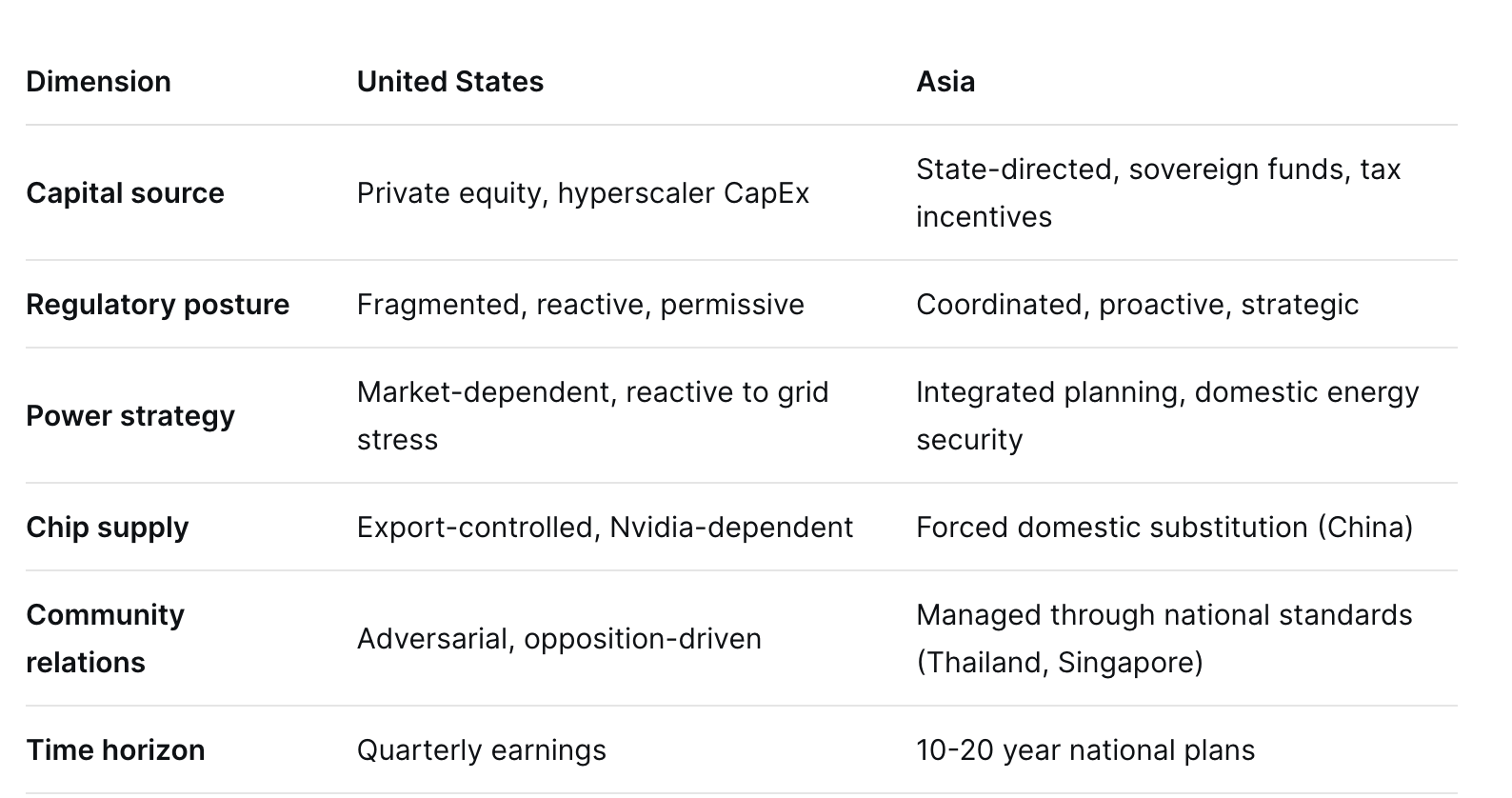
The US model assumes that capital can overcome physics. It cannot. The Asian model recognizes that infrastructure development is a political and resource-allocation problem, not merely a financial one.
The Outlook: Brutal, Not Fatal
The AI data center boom is not going to disappear. The demand for compute is real, and the strategic importance of AI infrastructure is undeniable.
But the American-style, unregulated, private-capital-driven buildout is finished. The $286 billion in blocked and delayed projects is not a temporary setback. It is a structural correction. The communities that have rejected these projects are not going to change their minds. The grid constraints are not going to disappear. The ROI gap is not going to close by itself.
The brutal truth is this: the AI data center bet was never about technology. It was about whether societies were willing to absorb the physical and social costs of a new industrial revolution. In the United States, the answer is increasingly no. In Asia, the answer is yes but only on terms that the state, not the market, defines.
The winners will not be the companies that spent the most. They will be the jurisdictions that planned the best. And right now, that is not the United States.
_________________________________________________________________________
This piece appeared in LinkedIn on October 6, 2026. We highly recommend you follow Dr. Naidu for his extraordinary insight.
TheBlackSwanFiles.Substack.com
The Black Swan Files is a reader-supported publication. To receive new posts and support my work, consider becoming a free or paid subscriber.
The trillion-dollar wager on AI data centers is not a growth story.
It is a slow-motion structural failure, and the evidence is now impossible to ignore.
What follows is the full accounting of the dead projects, the broken grids, the burning capital, and the cold, calculating counter-strategy emerging from Asia.
Part I: The American Delusion – A Full Accounting
The Dead and the Dying
In September 2025, Google walked away from a $1 billion data center outside Indianapolis, pulling its Franklin Township proposal minutes before the city-county council was set to vote it down. That was not an isolated incident. It was the opening act of a rout.
Communities across the United States blocked or delayed more than $130 billion in AI data centers in the first three months of 2026 alone, a record quarterly pace that has only accelerated. In 2025, at least 48 data center projects worth approximately $156 billion were blocked or stalled due to local opposition. Combined, the total capital stranded or delayed by community resistance now exceeds $286 billion.
The trajectory is brutal and unambiguous.
Project cancellations jumped from six in 2024 to 25 in 2025, with more than 20 additional cancellations already logged in early 2026.
From January 2024 to May 2026, 46 AI data center projects across 20 states, representing investments between $137 billion and $172 billion, were stalled, blocked, or withdrawn entirely.
The corpses are piling up. In Arizona, a $14 billion project by Tract was withdrawn outright. In Virginia, a $24.7 billion QTS/Compass project became the target of lawsuits from local residents. And in July 2026, Blackstone’s QTS terminated its planned Digital Gateway data center project in Virginia, the largest data center campus ever proposed after years of local opposition and litigation.
If a project of that scale, with that level of political backing, cannot survive, no project is safe.
The Political Revolt
The numbers tell a story of a political shift that is tectonic in its speed. In August 2026, a survey of 2,007 U.S. adults conducted by Public First and the Information Technology and Innovation Foundation found that 46% of Americans oppose new data center developments in their communities, while barely 26% support them. Data centers are now the least favored form of local development among 10 types tested, less popular than warehouses, power plants, or wind farms.
The Annenberg Public Policy Center’s survey, also from August 2026, found that 61% of U.S. adults now somewhat or strongly oppose the construction of new data centers in their area, up from 49% just four months earlier. Only 14% are supportive. This is not a fringe movement. It is a broad, bipartisan revolt.
833 active community groups have sprung up across 49 states as of March 2026, united by complaints about massive electricity consumption, excessive water usage, noise pollution, air quality, and a permitting process many describe as opaque. New York imposed a moratorium on large new data center facility proposals in July 2026. Texas and New York have paused the issuance of permits for large data centers.
The industry’s response has been to seek out locations with fewer residents and less political friction. But those sites often lack the power grid infrastructure needed. The accelerating cancellation rate from 6 in 2024 to 25 in 2025 to 20 more in early 2026 indicates that community awareness is spreading faster than the industry’s ability to address concerns.
The ROI Catastrophe
The financial logic underpinning the entire buildout is collapsing under the weight of its own contradictions.
Bain & Company’s Automation and AI Pathfinder Survey 2026, covering 951 global companies, found that 40% of companies that tracked their AI spending recorded cost savings of less than 10% far below the 11% to 20% they had targeted. Only 4% of global respondents achieved AI-related savings of more than 30%. Bain’s report described the situation bluntly: “In reality, it is a circular bet with a structural leak.”
The Fifth Annual Domino Enterprise AI Report, which surveyed 639 senior enterprise AI leaders, found that the share of enterprises whose ROI fails to outpace their investment has remained at 57% since 2025, a plateau that has persisted for two years in a row, even as 93% report improved production capability.
The gap between capability and value is not closing. It is widening. Over 50% of enterprise AI budgets are allocated to sales and marketing functions, the areas where financial impact is hardest to isolate. Only 5-8% of enterprises can actually measure AI’s financial impact. And 49% of large organizations have cut AI agent rollouts when costs outran value.
The anecdotal evidence is just as damning.
Uber blew through its entire 2026 AI budget in the first four months.
Amazon shut down an internal leaderboard tracking employees’ AI activity after staffers were found running unnecessary autonomous bots to climb the rankings, a perfect metaphor for the performative nature of much corporate AI spending.
Part II: The Power Grid Is Breaking – And Ratepayers Are Paying
Virginia: The Canary in the Coal Mine
Virginia hosts the world’s largest concentration of data centers, and its grid is buckling under the weight. The numbers are staggering.
Dominion Energy’s Virginia Electric unit had fuel expenses of $2.31 billion in 2021. By June 2027, that figure is projected to reach $4.35 billion, an 88% increase. Fuel costs are the expenses Dominion pays to buy the coal, natural gas, and nuclear fuel to generate electricity.
The utility is increasingly forced to purchase power on the volatile wholesale market, where spot prices can skyrocket to several thousand dollars per megawatt hour during heatwaves and extended cold snaps.
23% of Virginia Electric’s energy supply now comes from the PJM wholesale market, up from 14% in 2021, driven directly by data center demand. The regional grid operator, PJM Interconnection, serves 67 million people from Washington, D.C. to Chicago, and its capacity market prices have risen sharply in recent adjustments.
The impact on ordinary Virginians is direct and painful. Virginia regulators approved rate increases of $11.24 a month for residential customers in 2026 and another $2.36 in 2027. Fuel costs could drive up the average monthly bill by as much as 13% to $195 from $173. The increase would only be about 5% if Dominion can issue bonds to defer some fuel cost recovery a band-aid on a hemorrhage.
The political backlash is already forming.
Governor Abigail Spanberger, a Democrat, said she would intervene in the regulatory review of NextEra Energy’s proposed $66.8 billion merger with Dominion to press for commitments on power bill affordability. The utility regulator’s staff said significant load growth from data centers increasingly exposes Dominion to wholesale market volatility.
Virginia’s experience shows what happens when digital infrastructure expands faster than the electric system can support. The state is now the canary in the coal mine for the entire American AI buildout.
South Korea: A Preview of the Coming Crisis
South Korea offers an even starker warning. AI data centers are projected to consume 128.9 TWh annually by 2037, equivalent to approximately 23.5% of the country’s total electricity consumption in the previous year of 549.4 TWh.
The government has announced plans for 18.4 gigawatts of AI data centers and four semiconductor fabrication plants requiring 6.3 gigawatts of power. If operated around the clock, the AI data centers would require about 161.2 terawatt-hours of electricity a year, while the new semiconductor fabs would need about 55.2 terawatt-hours.
60% of AI data center applications are concentrated in the Seoul metropolitan area, where the grid is already saturated. The government has been forced to introduce grid impact assessments to push development outside the capital region. This is not a market solution. It is crisis management.
Part III: Asia’s Counter-Strategy – State Power, Not Private Fantasy
While the United States relies on private capital racing into a regulatory vacuum, Asia is pursuing a fundamentally different model: state-directed, strategically prioritized, and resource-aware development.
The contrast is not subtle. It is civilizational.
China: $295 Billion and a Wall Around Nvidia
China is preparing to spend approximately 2 trillion yuan ($295 billion) over five years on building a nationwide network of AI data centers. State-owned telecom carriers like China Mobile and China Telecom will operate most of these facilities. The plan, led by the National Development and Reform Commission, mandates that at least 80% of AI accelerators used be domestically produced.
The strategic objective is explicit: domestic chip self-sufficiency.
In May 2026, nine domestic AI chips, including those from Huawei, Alibaba, Shanghai Biren Technology, and Moore Threads, passed review by China’s technology security agency, paving the way for large-scale adoption in high-security industries. Citigroup analysts believe the 80% localization target is achievable, as domestic AI chipmakers have already effectively captured the vast majority of China’s AI accelerator market, while imports of Nvidia’s H200 have essentially stalled.
Critically, power supply is less of a constraint for China.
Data centers currently account for only around 3-4% of the country’s total power consumption, and that figure is projected to rise to just 4.0% by 2026. China is not racing into a grid crisis. It is building with its eyes open.
India: A 21-Year Tax Holiday and a $70 Billion Bet
India has taken the most aggressive fiscal stance in Asia. The 2026-27 budget introduced a tax holiday until 2047 for foreign companies providing cloud services to customers globally using data center services from India. The exemption applies from Tax Year 2026–27 to Tax Year 2046–47 a 21-year commitment that no other major economy has matched.
A safe harbor of 15% on cost has also been proposed where the data center service provider in India is a related entity. The government says investments of around $70 billion are already underway, with announcements of investments of around $90 billion.
This is not speculative capital chasing a hype cycle. It is policy-driven infrastructure investment with a 20-year horizon. India generates nearly 20% of the world’s data but currently stores only a fraction domestically. The tax holiday is designed to close that gap.
Thailand: The Brake That Will Save the Market
In September 2026, Thailand’s government made the most decisive intervention in the region: it paused 166 data center projects, 49 already under construction and 117 awaiting approval, while government agencies drafted nationwide standards governing water, power, site selection, and environmental safeguards.
Deputy Prime Minister and Finance Minister Ekniti Nitithanprapas framed the pause not as rejection but as prioritization: Thailand wants projects that “generate jobs, income, and technological benefits,” not “simply providing space for servers.”
The decision exposed a fundamental flaw in the industry’s expansion: investors currently seek permission separately from electricity utilities, water authorities, and local building regulators. Each agency assesses matters within its remit, leaving no single body with a complete view of a project’s resource needs, proximity to communities, or economic returns relative to its costs. Some data centers are even registered under other business categories, including warehousing, making it harder to establish the industry’s true scale.
Four subcommittees have been given one month to prepare new criteria covering economic benefits, infrastructure, locations, and the environment. The new rules will regulate water and electricity use, locations, and safety while promoting clean energy and technology transfers.
This is what adult supervision looks like.
Singapore: Controlled Liberalization with Green Mandates
Singapore, which imposed a moratorium on new data center builds from 2019 to 2022, has reopened its market but on its own terms. The second Data Centre Call for Application (DC-CFA2) allocated 200 MW of new capacity, more than double the 80 MW allocated under the first exercise, to four operators: Digital Realty, Equinix, Keppel Data Centres, and ST Telemedia Global Data Centres, each receiving 50 MW.
The mandates are non-negotiable. Operators must meet at least half of the new facilities’ power consumption via green energy and deliver best-in-class energy-efficient performance, including through the adoption of liquid cooling. They must also enhance Singapore’s advanced compute capabilities for AI and facilitate R&D via collaborations with Singapore-based partners.
More than 20 projects bid for the capacity, and the authorities confirmed the four projects were selected “for their ability to holistically meet the desired outcomes” across strategic, economic, and sustainability components.
As Nicholas Hanna of Pinsent Masons MPillay put it, “Singapore is making clear that access to capacity here comes with real obligations: on technology, on economic contribution, and on green energy. Green energy obligations, R&D partnership arrangements, and infrastructure development timelines are no longer peripheral considerations in a data center deal in Singapore. Instead, they sit at the center of it.”
This is not a market free-for-all. It is managed growth with hard sustainability guardrails.
Malaysia: The Spillover Beneficiary
Malaysia, particularly Johor, has become the primary beneficiary of Singapore’s constrained capacity.
AirTrunk is investing RM12 billion ($3.02 billion) to build two new hyperscale campuses in Iskandar Puteri, Johor, called JHB3 and JHB4. The four campuses will have a combined IT load of more than 700MW, bringing the company’s total committed investment in Malaysia to approximately RM27 billion ($6.8 billion).
In the first half of 2026, data center and cloud projects accounted for 44% of Malaysia’s total approved investments. Disclosed data center transactions in Johor alone totalled RM1 billion in that period. YTL Power is developing a gigawatt-scale campus in Sedenak. Malaysia is capturing demand that Singapore cannot physically accommodate and doing so with a clearer regulatory framework than the United States.
Japan: AI Sovereignty as National Strategy
Japan is pursuing what it calls “AI sovereignty,” building domestic infrastructure to reduce reliance on both the US and China. AI data center capacity is projected to grow from 1.1 GW at the end of 2025 to 4.9 GW by 2033, a 4.5-fold increase.
The investment commitments are staggering. Blackstone plans to invest $30 billion in Japanese AI data centers over the next three to five years, developing more than 1GW of capacity. GMI Cloud has launched a $12 billion sovereign AI infrastructure initiative in Japan, partnering with Wistron to build a 1 GW facility in Kagoshima Prefecture. Microsoft alone has committed $10 billion to expand its AI and cloud infrastructure in Japan from 2026 to 2029.
Of the 26 major companies operating data centers in Japan, 22 plan to expand AI-facing infrastructure. This is not a speculative bubble. It is a long-term strategic commitment backed by corporate and state capital.
Part IV: The Structural Difference
The American AI data center market is failing because it relies on private capital racing into a regulatory and physical vacuum. The result is predictable: local opposition, grid strain, rising costs for ordinary citizens, and a growing pile of stranded assets.
Asia’s approach is different in kind, not just degree:
The US model assumes that capital can overcome physics. It cannot. The Asian model recognizes that infrastructure development is a political and resource-allocation problem, not merely a financial one.
The Outlook: Brutal, Not Fatal
The AI data center boom is not going to disappear. The demand for compute is real, and the strategic importance of AI infrastructure is undeniable.
But the American-style, unregulated, private-capital-driven buildout is finished. The $286 billion in blocked and delayed projects is not a temporary setback. It is a structural correction. The communities that have rejected these projects are not going to change their minds. The grid constraints are not going to disappear. The ROI gap is not going to close by itself.
The brutal truth is this: the AI data center bet was never about technology. It was about whether societies were willing to absorb the physical and social costs of a new industrial revolution. In the United States, the answer is increasingly no. In Asia, the answer is yes but only on terms that the state, not the market, defines.
The winners will not be the companies that spent the most. They will be the jurisdictions that planned the best. And right now, that is not the United States.
_________________________________________________________________________
This piece appeared in LinkedIn on October 6, 2026. We highly recommend you follow Dr. Naidu for his extraordinary insight.
TheBlackSwanFiles.Substack.com
The Black Swan Files is a reader-supported publication. To receive new posts and support our work, consider becoming a free or paid subscriber.