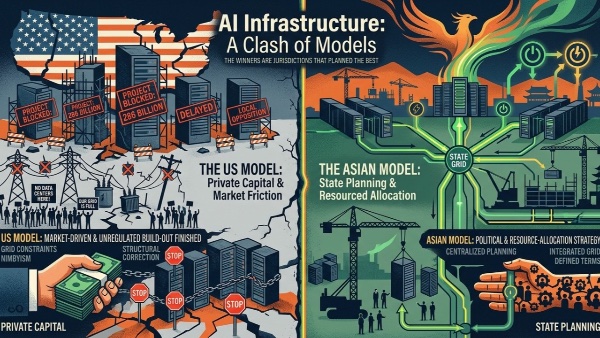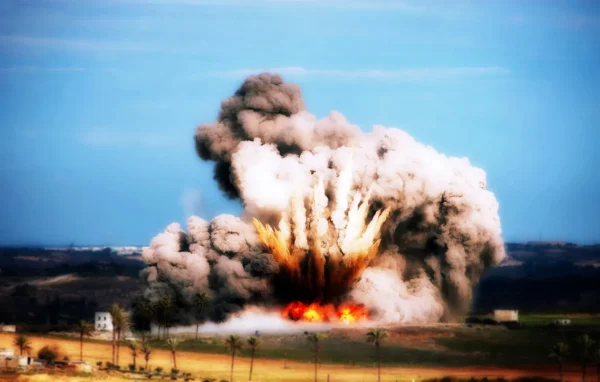
There are few greater national security threats – than the centralization of command and control data – in 4 or 5 centralized data centers – each of which is vulnerable to a single, inexpensive EMP device.
If 4 U.S. Government Amazon data centers were taken out, by instantly exploding a single EMP device in the sky over each, the U.S. Government would come to its knees.
The Black Swan Files is a reader-supported publication. To receive new posts and support my work, consider becoming a free or paid subscriber.
That is what “single point of failure” means and the United States is hurtling toward fully embracing a centralized computing strategy – driven by donors who must rely on such data centers – because they use 1980s tech stacks – creating this possibly fatal danger.
America is in far greater danger today from hyperscale data centers which can be instantly destroyed than it will ever be by anything A.I. can deliver.
As you evaluate the nonsensical hype about A.I. taking over the world, that America must remain ahead of China in A.I., you may want to consider what happens in a world where everything is centralized and the next conflict will likely be a “systems conflict.”
What exactly is “systems warfare?”
Here is a short A.I. summary:
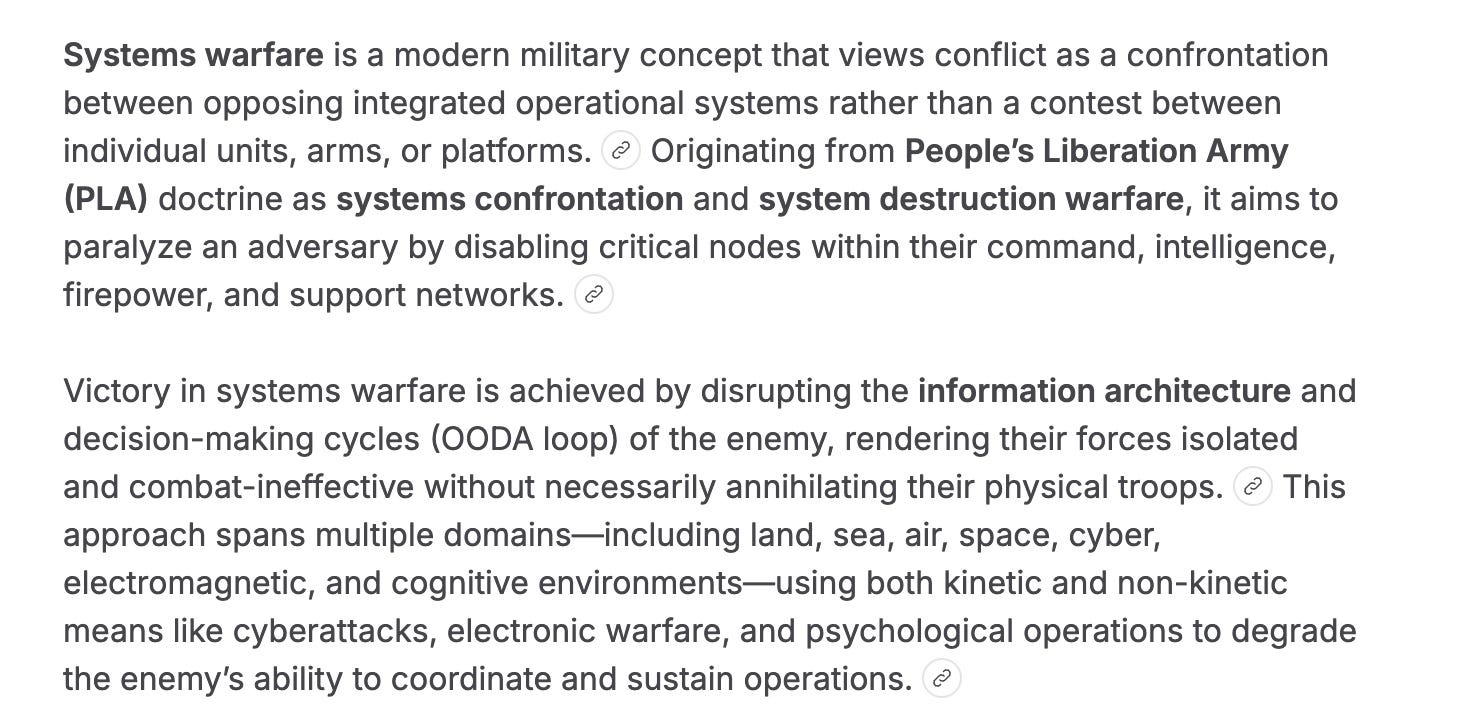
As you can see, even if you are not a military strategy geek, the way to lose at this new game is to centralize your computing assets so an opponent can take them out – drive you to your knees – no navies, armies or invasions necessary.
Centralized computing – which means the cloud – which means the hyperscale data center with your Chat GPT A.I. inside – is the equivalent of bunching all your fighter jets into the same corner moments before your adversary attacks.
We hear, incessantly, from the A.I. centralized data center crowd that China is deliberately undermining the U.S. A.I. strategy of building centralized data centers?
Really?
There is nothing the Chinese, or any potential adversary, could do to more hobble America’s future than beg Americans to put all their A.I. eggs into that one basket – the hyperscale data center.
As Americans build gargantuan data centers, A.I. targeting systems in countries around the world – who understand what asymmetric warfare entails, lather up ready to – with one explosion, one plane, one inside person on a mission – cause more havoc than the World Trade Center tragedy.
Systems level warfare isn’t something you bounce back from in a few weeks – it cripples your country, turns citizens into virtual cave men as food, electricity and transportation become difficult to deliver.
America cannot respond if all or part of its electric grid is taken down – which is quite easy to do – unfortunately. That is a systems level attack.
If 4 data centers – each currently well known – are rendered inoperable, the U.S. Government would go to its knees.
This is not a fatuous claim.
You are witnessing asymmetric warfare in the Middle East – if you care to look – where multi-billion aircraft carriers, interceptor systems – are rendered close to useless as the U.S. fires off multi-million dollar missiles to stop incoming iron costing a few thousand dollars.
The outcome?
The U.S. is running out of hardware – the other guy – not so much so.
Why does America rely on central command and control and the Chinese do not?
Oh, wait, is that news to you?
Perhaps you did not know the Chinese military has gone fully distributed with its computing, beginning with its drone swarming, making a single point of failure impossible to achieve.
Well, let’s go there for a moment because the tech press will not tell you what Palantir, Oracle, Andruil and other donor defense firms – who are centralized command and control – do not want printed.
A stunning piece in the South China Morning Post reported the Chinese Government DEVELOPED a SWARM battlefield weapons system completely distributed – that can survive anything the Americans can throw at it.
It is a “self-healing network,” with “thousands of highly resilient A.I.- driven kill weapons – un-crewed aerial, surface and underwater.”
The article sent shockwaves through the Pentagon and the war fighter vendor community surrounding Washington DC – because few considered the Chinese could solve the “drones as a flock of birds challenge.”
Drone warfare is the new thing and today, we are informed, the U.S. can also do drone “swarming” – but only for 10 drones, actually only 3 or 4, not 10,000 or 100,000 – all controlled from a single joystick.
The Chinese can swarm 10,000 or 100,000 cheap drones – from a single point – no central control – the U.S. can do 10.
Think 10,000 cheap drones, operating like a flock of birds might be a threat?
Think about that.
So is A.I. really the scariest possibility now?
When you hear America must keep ahead of China in A.I. you might want to think that through.
What is the benefit of America having data center campuses (campi if you took Latin in high school) which are vulnerable to inexpensive devices – when the Chinese do not have such limitations?
The Chinese war doctrine is not donor driven – the U.S. war doctrine is driven by obsolete tech companies, built with 1980s techology which require these centralized command and control structures.
This week we sat for an interview on this very subject.
The question was what will change America’s headlong strategy of building huge, centralized targets – data centers – to be hobbled by systems level, asymmetric attacks in the future?
The answer is pretty clear.
There will likely, sadly, be an early conflict where one of these data centers is taken out – wait – that almost happened!
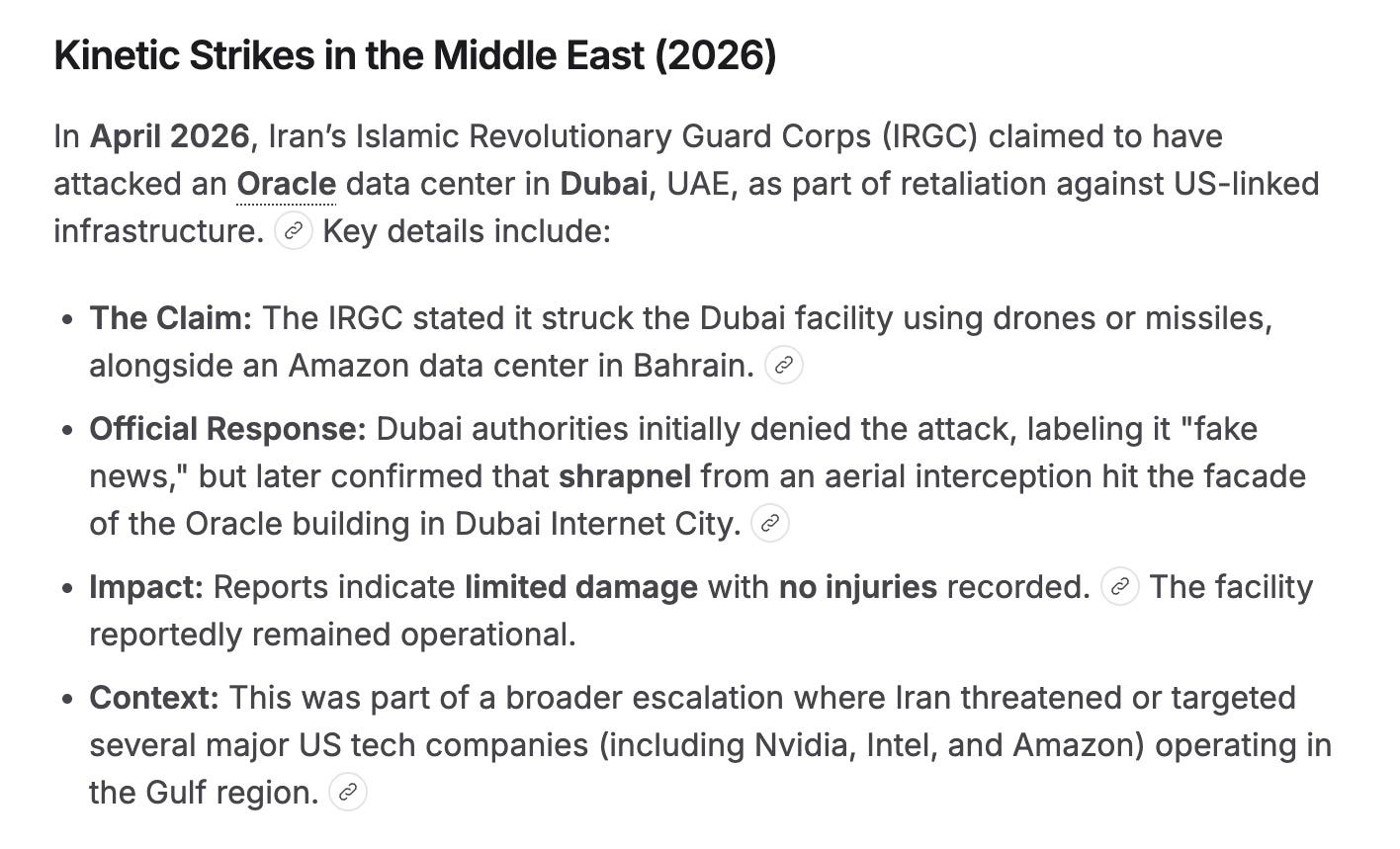
In this case, a third world country, who we are told has no air force, no navy, is on its knees, attacked an Oracle data center.
Was there damage? Was it destroyed? That hardly matters; think of what the Chinese could have done.
The point is clear – centralized data centers and software requiring such monoliths, are obsolete – and the first successful EMP attack on a data center and the point will be proven – even to the Wall Street Journal and MIT Tech Review stenographers.
Do we want to wait for catastrophe?
Do we want to maybe follow the Chinese lead – noted above in the drone article – of building survivable systems that can survive a systems level conflict?
Of course we do and many of us are doing just that – which you will not read about because Palantir, Oracle, META and Elon are making sure you are terrified your kids will be speaking Mandarin if they don’t get access to your water and electricity.
Distributed computing is the future of all compute – in war, in business, in your home and throughout your life.
Distributed compute is going everywhere because data is collected everywhere – on your watch, fridge, car, phone and it needs to be computed – the work must be done, where the data resides, not sent to Elon.
Here is a short video on why the overwhelming data now collected – dwarfing every A.I. system on the planet – comes from sensors, meters and devices – and cannot be centralized:
The Chinese get this, and fortunately for their citizenry, China’s defense strategies are not driven by donors needing to save their tech companies from the shock wave of massively high I/O artificial intelligence making them more obsolete by the day.
We built a website to cover many of these issues – DataCenterMadness.com and we encourage you to check it out.
We work with leading technology partners who understand the future is widely distributed, massively scalable computing which outperforms any data center on the planet – at 1/10th the cost – no data center needed.
These distributed systems can be implemented in a quarter or less – some in weeks – at a fraction of the cost of centralized compute.
And while you will not read much about advancements in distributed computing in the tech press – we will bring them to you here on TheBlackSwanFiles.Substack.com.
The point you may want to consider is perhaps, just perhaps, the single most meaningful change in computing economics is not the size or scope of A.I. – but the distribution system making A.I. available everywhere – and anyone can benefit from it.
That is what we are discussing here – and we suggest you think those implications through.