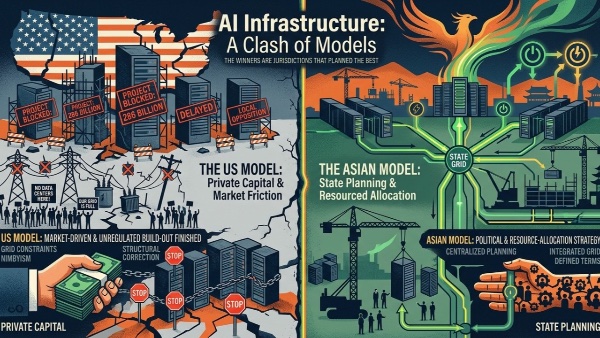
If you want to fight the Data Center Madness, you cannot rely on knuckleheads on Twitter who never built a major computer technology – never took a new technology to market.
You need to educate yourself about one of the most disruptive technologies in history.
We provide those articles here.
Jim Calhoun is a true visionary – yes, his stuff is a bit technical – but you NEED to know this material to win the argument – America does NOT need hyperscaler data centers.
Other countries are achieving equal or better A.I. results without these massive data centers.
We thank Jim for allowing us to present his articles here on the site.
We look forward to doing an interview with him someday.

Jim Calhoun
Entrepreneurial Executive | Software Architect | Founder, The Grove Foundation
February 18, 2026
While America Pours Concrete, China Releases Code
Earlier this month, Alibaba open-sourced a sophisticated vector search engine called zvec. You install it with a single command. It runs entirely on your machine. No server. No cloud account. No subscription. On a standard laptop, it handles more than 8,000 queries per second across 10 million vectors — double the throughput of the previous best-in-class managed service.
Almost simultaneously, the Stargate Project pushed forward on its massive U.S. expansion — with construction now underway across multiple sites in Texas, New Mexico, and Ohio. The $500 billion initiative — the largest private infrastructure project in American history — aims to concentrate AI computing power into a handful of gigawatt-scale facilities. The White House calls it the “Manhattan Project for AI.”
These two events tell the same story from opposite ends. And only one of them matches what actually happens when infrastructure technology matures.
The Most Important AI Release Nobody Covered
Zvec is not a startup demo. It is Alibaba’s production vector search engine — the same technology powering product recommendations on Taobao, fraud detection on Alipay, and content matching on Youku — extracted, shrunk, and handed to anyone with a Python environment. The internal name is Proxima. It processes billions of queries daily across Alibaba’s infrastructure. Now it processes them on your laptop.
Vector search is the memory layer of modern AI. Every time an AI application retrieves relevant context, matches similar content, or “remembers” prior interactions, it runs a vector search. Until zvec, that capability required either a managed cloud service like Pinecone or a self-hosted database server like Milvus. Both require infrastructure teams. Both generate monthly bills. Both create dependency on external providers.
Zvec eliminates all three. It is an in-process library. It lives inside your application the way SQLite lives inside your phone. There is nothing to deploy, nothing to manage, and nothing to pay for beyond the hardware you already own.
This Exact Pattern Has Played Out Before
In 2000, a software engineer named Richard Hipp needed a database for a U.S. Navy destroyer program. The existing options — Oracle, PostgreSQL, the usual suspects — all required a dedicated server process. Hipp wanted something simpler. He built SQLite: a database engine that ran inside the application itself. No server. No configuration. One file.
Experts told him it would never work. A real database requires a server. Everyone knew that.
Today, SQLite is the most deployed database engine on Earth. It runs on more than four billion smartphones. Every major web browser ships it. It powers iMessage, WhatsApp, and every Android app that stores data locally. There are an estimated one trillion active instances worldwide.
SQLite did not replace Oracle. It created a category so large that Oracle’s entire market looks modest by comparison. The trick was simple: when powerful technology becomes embeddable, it doesn’t take share from centralized providers. It creates billions of use cases that centralized providers could never reach. No one is going to provision an Oracle database on four billion phones. But just about anyone can ship an embedded SQLite database.
Alibaba sees vector search following the same arc. There are millions of AI applications that need semantic search but will never justify a Pinecone subscription. Edge devices, personal tools, offline applications, embedded systems, privacy-sensitive workloads. Literally billions of use cases don’t exist yet because the infrastructure cost has been too high. Zvec makes it zero, and that changes the calculus entirely.
The Cost Always Forces the Collapse
Useful technology infrastructure doesn’t spread because of ideology. It spreads because economic gravity demands it.
Managed vector databases like Pinecone are toll booths on the road to intelligence. A basic instance starts at $50 per month, but as soon as a company moves from a prototype to a production workload with tens of millions of vectors, that bill balloons to $3,000 or more. At enterprise scale, you are not just paying for search. You are paying a tax on every memory your AI retrieves.
This creates a value gap. When the cost of a centralized service exceeds the cost of local hardware and electricity by 1,000 percent, the market does not just tip. It collapses toward the edge.
Turns out, all the strategic insight you need to counter “the Manhattan Project of AI” exists in high-school level market economics. Huh.
Zvec is the realization of the Jevons Paradox for AI. By making vector search free and local, Alibaba is not just saving developers money. They are enabling a volume of queries that would bankrupt a company using a centralized provider. When the marginal cost of a search hits zero, you do not just do the same searches for less — you embed search into every microscopic interaction of the application. Every personal device running local semantic search. Every embedded system with memory. Every offline application that needs to retrieve context without a network call. These are not edge cases. They are the entire next generation of AI applications — and none of them can exist at $3,000 per month per instance.
This pattern has played out in every infrastructure cycle. Databases. Web servers. Machine learning inference. The only question for vector search was when, not whether.
Alibaba Is Cannibalizing Its Own Cloud Revenue — On Purpose
Here is the part that should make American infrastructure planners uncomfortable. Alibaba Cloud is one of the world’s largest cloud computing platforms. They sell managed database services — including DashVector, their own managed vector search product built on the same Proxima engine. They profit directly from the centralized model. Releasing zvec under an Apache 2.0 open-source license cannibalizes their own entry-level market.
They did it anyway. Why?
Alibaba understands something the U.S. Stargate consortium does not: the value is migrating from infrastructure to the intelligence layer. If AI capabilities distribute to the edge — running inside applications on personal devices and local servers — then the providers who enabled that distribution own the ecosystem. The ones still building centralized fortresses own expensive real estate.
This is not a new strategic insight. Google gave away Android to own the mobile ecosystem. Facebook open-sourced React to own the development ecosystem. Alibaba is giving away the memory layer of AI to own the next platform shift. The infrastructure itself becomes a loss leader for everything built on top.
The $500 Billion Bet Against Technological History
The Stargate Project is premised on a specific belief: that AI is a “Fortress” technology. It assumes that intelligence requires ever-increasing concentrations of power, housed in centralized facilities, and metered out by a handful of providers. The White House frames this as national security; OpenAI frames it as the path to AGI; Wall Street frames it as a generational investment.
To be fair, Stargate serves a vital purpose: Training. Building frontier models requires a concentration of compute that no edge device can replicate. But training is only the “heavy lift” phase. The other half—inference and retrieval, the actual use of intelligence by actual people—is where the value is captured. And that half is distributing at a rate that should terrify centralized planners.
If the U.S. builds a $500 billion fortress for training while the “last mile” of intelligence is delivered via lightweight, distributed tools, we have built a massive power plant with no power lines. We are winning the war for the “Core” while losing the war for Ubiquity.
The Sovereignty Gap
The implications for Sovereign AI are stark. A centralized Stargate model requires every user to send their “vectors”—their proprietary knowledge, customer data, and institutional memory—to a third-party data center. In an era of corporate espionage and strict data residency, this is more than an inconvenience; it is a structural vulnerability.
Zvec allows an enterprise to keep its entire knowledge layer behind its own firewall. No API calls. No data leaving the building. No ongoing token fees. It offers a security posture that centralized infrastructure cannot replicate by definition.
The Law of Computing Gravity
This shift follows the most reliable pattern in technological history:
- Computing: Mainframes → PCs and Smartphones
- Data: Oracle → SQLite and DuckDB
- Intelligence: Stargate → Zvec and Local LLMs
In each cycle, centralization proves the concept, but distribution wins the market. The timing is predictable: frontier performance typically propagates to consumer hardware on an 18-to-24-month cycle. The capabilities Stargate is building cathedrals to house today will, by historical precedent, be running on your phone within two years.
None of this means large-scale compute becomes worthless. Oracle still exists, and AWS still prints money. But the Stargate thesis assumes that inference — the actual use of AI by actual people — will remain centralized indefinitely. Zvec is the data point that proves the intelligence layer is already collapsing toward the user. This GDP-scale buildout serves one master: the frontier model owner.
Concrete Dries Fast
The infrastructure choices being made in the U.S, right now — in Texas, in New Mexico, in Ohio — will shape the architecture of American society for decades to come. Those data centers have 30-year lifespans and gigawatt power contracts. They are structural commitments to a specific vision of how intelligence gets delivered: centralized, metered, and controlled by a handful of companies with the capital to consolidate the market for knowledge processing.
Meanwhile, a single Python package from Alibaba just made one of the most expensive components of AI infrastructure free, portable, and permanent. Not as a research project. As production-grade technology extracted from systems processing billions of queries daily.
The question is not whether AI infrastructure will spread. That pattern is as old as computing itself. The question is whether we as Americans will wise up to the risks of the path we’re on before it is too late. While we are busy debating the permits for the next gigawatt, the Chinese are already shipping the code that makes the gigawatt unnecessary.
Black Swan Note: Follow us on our new website – DataCenterMadness.com
We hope to see you there.